Showing posts with label banana. Show all posts

January 8, 2022

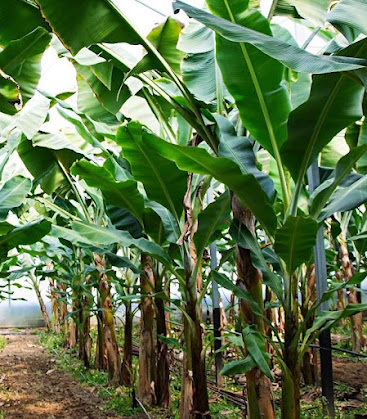
Climate for banana cultivation

Banana is a semi-perennial crop with a crop cycle nearly a year long under optimum conditions and even longer with lower temperatures or more erratic water supply.

Banana plants like warm and wet conditions also rainy climate year-round, along with fertile soils. Bananas need adequate moisture and protection from wind.

They grow best in the tropics, with an average temperature in the high 20s Celsius, and can be found in plantations in a wide band between 30° north and south of the equator.

Most varieties of bananas grow best with 12 hours of bright light and high humidity of 50% or higher. The ideal temperature range is around 26-30°C with RH regime of 75-85%.

Growth begins at 18ºC, reaches optimal growth at 27ºC and stop entirely when temperature reaches 38ºC.

Banana thrives in fertile, well-drained soils with high water-holding capacity. The optimal pH is between 5 and 7. Because banana is sensitive to salinity, the EC should not exceed 1.0 dS/ m.

Bananas are found in southern Europe, northern Africa, Pakistan, northern India and China at their northern extreme and in Argentina, Paraguay, South Africa and Australia at their southern extreme.

They are also grown in the tropics into mid-altitudes of higher than 1 500 meters above sea level in the Andes, Himalayas, Kilimanjaro and the East African Highlands.

Commercial plants are usually grown to just a few meters tall and are replanted every six years or so using the bulbous shallow-rooted rhizomes (called corms) that the adult plants produce.
Climate for banana cultivation
September 20, 2021

Bioactive compounds in banana

Bananas are the creamy flesh and sweet fruit, with firmness, which are packaged in their yellow jackets. Bananas are one of the most consumed fruits in tropical and subtropical regions.

Free radicals may be produced continuously which cause serious diseases, like heart disease, cancer, arthritis, inflammation and aging. Antioxidants are those agents which can scavenge the free radicals and inhibit the damage caused by them. The best antioxidants found in nature so far are vitamin C, vitamin E and the carotenoids.

Banana contains antioxidants and phytochemicals such as Vitamin-C, Vitamin-E, flavonoids and β-carotene which have free radical scavenging activity. Some enzymes of banana flesh increase the antioxidant capacity.

These tropical fruits have strong ability to protect themselves from the oxidative stress caused by the intense sunshine and high temperature by increasing their antioxidant levels. They are known as a weak primary antioxidant source but a powerful secondary antioxidant source.

Carbohydrates, norepinephrine, serotonin, dopamine, tryptophan, indole compounds, alkaloids, tannin, ascorbic acid, several flavonoids and related compounds (Leucocyanidin, quercetin and its 3-O-galactoside, 3-O-glucoside, and 3-O-rhamnosyl glucoside) have been isolated from the pulp of different bananas. Sterols such as β-sitosterol, campesterol, stigmasterol were isolated from the fruit, peel and plant.

Recent studies demonstrated that banana peel generally include higher phenolic compounds than that of banana pulps. It was reported carotenoids such as β-carotene, α-carotene and different xanthophylls in the range of 300–400 μg lutein equivalents/100 g. Researchers attributed antioxidant properties of banana peel to its gallocatechin content.
Bioactive compounds in banana

October 5, 2019

Soil requirement for growing banana

Banana growth slows below 16 °C and stops at 10 °C. Temperatures below -2 °C may kill plants to ground level. However, new growth usually sprouts from the underground rhizome with the return of warm weather.

Bananas do best on flat (slope 0–1 %), well-drained, deep soils high in organic matter with a pH of 5.5 to 7.0. Low pH soil makes banana more susceptible to Panama disease. Avoid soil that is sandy, salty, nutritionally deficient and ill-drained soil.

Nutritionally deficient soil can be improved by incorporating organic matter to the soil before planting the bananas and then mulch them thickly.

Clay loams are preferred with no heavy clay or rock shelves within 50 cm of the surface. Sandy soils are less suitable as they dry out rapidly, lose nutrients quickly, fail to provide adequate root anchorage in windy weather, have low nutrient retaining ability and are susceptible to serious erosion. Bananas do not tolerate waterlogging because its roots will rot.

Once the plantation is established, the soil should be managed to provide the best environment for the plant roots. This will involve the application of fertilizers and soil additives aimed at improving the physical, chemical and biological properties of the soil to benefit crop growth.
Soil requirement for growing banana

December 5, 2018

Production of banana in India

Banana belongs to family Musaceae in the order Scitaminae. India ranks second in banana production among the various banana-producing countries in the world.

In India banana is the most fruit produce by the famers next to mango. Agricultural activity is the major occupation in India. The major banana-growing states are Tamil Nadu, Andhra Pradesh, Kerala, Karnataka, Gujarat, Maharashtra, Bihar, West Bengal, and Assam.

Biodiversity in the cultivars of banana which consist of triploids, is complex especially in Nendran. Nendran belonging to Musa AAB plantain subgroup is the leading banana cultivar of the Kerala.

Banana leaf is considered as ‘biological plate’ for serving dishes especially in South India. Starch is manufactured form the pseudostem. Banana fiber from the pseudostem is utilized for making attractive carry bags and it is a potential source of pulp.
Production of banana in India

January 21, 2018

What are the symptoms of banana Panama disease?

The first records of this disease were in Australia in 1876. The disease is so virulent that in the early 20th century it killed nearly every banana plant in Suriname.

In 1931, Scottish agronomist Clause Wardlaw found Panama disease in 15,000 acres on Jamaica and 50,000 acres in Panama, from which it derives its name.

The first external symptoms of Panama disease are a yellowing of the oldest leaves or a longitudinal splitting of the lower portion of the outer leaf sheaths on the pseudostem of plants that are usually more than 4 months old.

Yellowing begins with the oldest and progresses to the youngest leaves of the plant. This is followed by wilting and buckling of leaves at petiole base. As the disease progresses younger and younger leaves collapse, until the entire canopy consists of dead or dying leaves.

However, fruits are not infected and are not discolored. This distinguishes fusarium wilt of banana from bacterial wilt of same plant. Panama disease presently is controlled through the use of resistant (Cavendish) varieties.
What are the symptoms of banana Panama disease?

Popular Posts

Other interesting articles